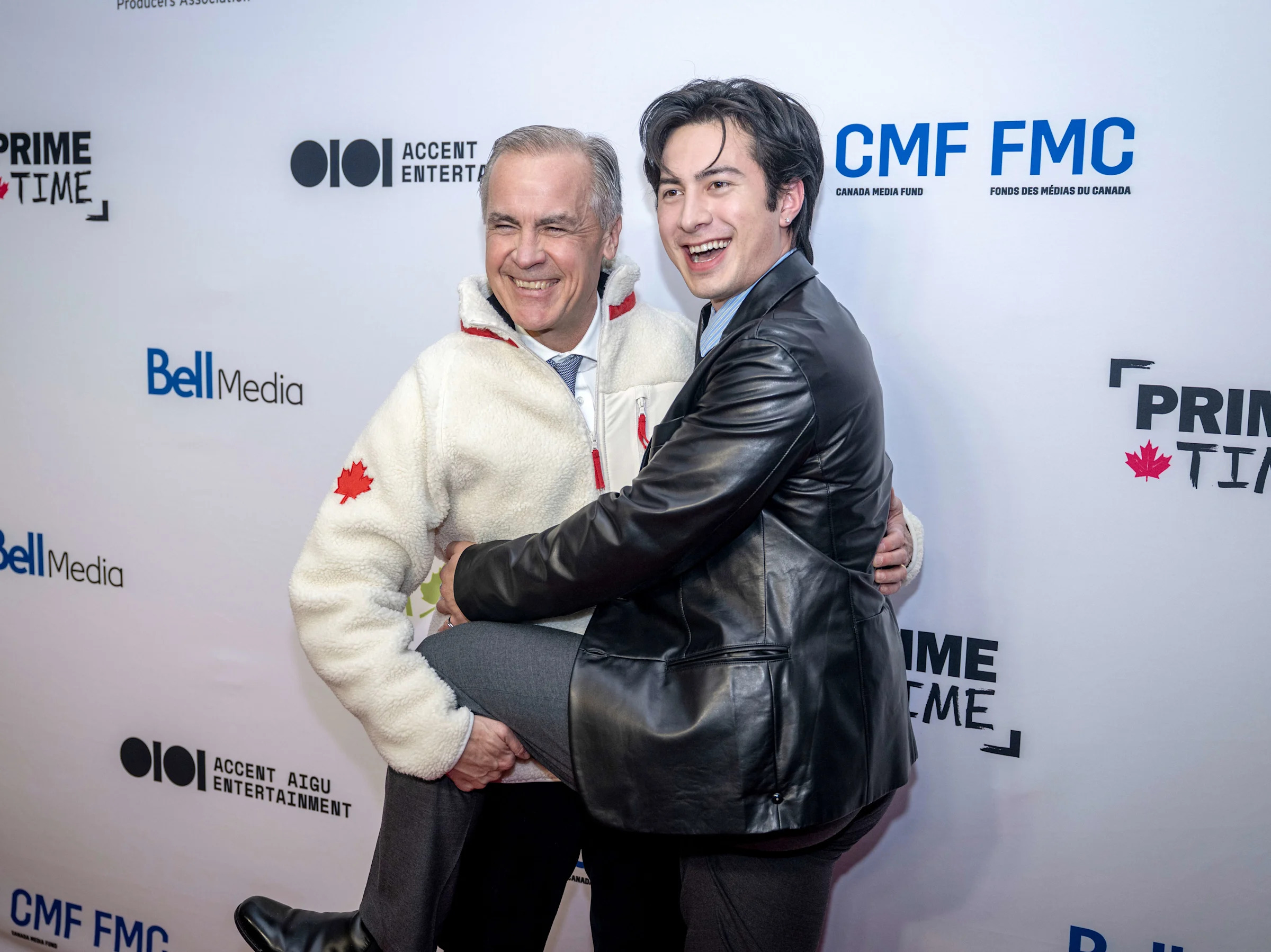
It’s been a fever dream of a week where Hudson William gave Mark Carney his Team Canada fleece1, it was declared Shane Hollander Day2 in Ottawa, and I was stranded downtown for 2 hours because the transit system is in chaos3, and my only question is: did Shane Hollander’s dad4 also get a letter saying, further to the Comprehensive Expenditure Review5, his position at Treasury Board may be effected6?
What Shape is Your Mind?
One of my favourite work pals, JC asked me a question that stuck with me last year: what do you imagine when you are trying to describe your mind? I haven’t settled completely on my answer, but the closet I got was somewhere between a knowledge graph, a library catalog, and a cloud. For the most part, it is molecules loosely grouped, other parts are carefully tended to and filed away, and yet others are semantically linked and retrieved relationally.
I bring this up because it is the best way I have to explain my brain7. To the chagrin of my mother, every teacher, and every manager I’ve ever had, I wander off; not always at very opportune moments, and both literally and metaphorically. It’s not always obvious to me why when we are bombarded with information, it’s like standing on a highway of rabbits, why a particular rabbit’s path down into wonderland is the one I must follow. It doesn’t always make me the easiest to try and teach or squeeze performance out of, particularly back when I didn’t understand or have developed techniques to corral myself.
The only way to find out how it all connects is to continue to add a new routes to the ecosystem map. Until one day, some kind of shape suddenly comes into focus. I had one of these joyful moments when a few different things crystallized into a question, “What do we owe to each other?”
What Do We Owe to Each Other?
There’s a lot being said about how transformative or existential this particular moment we are in is. In fact, that is the premise of the GovActionCafe event that I am planning for June 13, 2026 (learn more and register here).
Contexts like these, bring me back to my central ethos, which I started to articulate a few years ago in this presentation: Analogue tools for digital change: Teaching Data through Arts and Crafts - Google Drive. Back then my primary focus was on teaching and improving data literacy, and thus I had summarized that centre as using “caring and inclusive approaches to spreading the joy of data”. I will share briefly today how I arrived on it, some early thoughts what this looks like now that I am back in a practitioner role8, and bigger picture, is it sufficiently expansive to account for the other parts of my identity, life, and communities?
As a foundation to this central statement, on slide 4, I shared an integrated definition of trauma9:
“Trauma is a response to anything that’s overwhelming, and that happens too much, too fast, too soon, or too long. It is coupled with a lack of protection or support. It lives in the body, stored as sensation: pain or tension — or is a lack of sensation, like numbness. It does not impact us all in the same way. Context is critically important.” - Karine Bell, Resmaa Menakem, and Bessel van der Kolk10
In reflecting on this definition and starting to observe the people I am in relationship with, it’s pretty easy to see and understand that everyone I might encounter is carrying something around with them. It is through this lens that I view and think about my own responsibilities to others.
Over the weekend, I accidentally ended up arguing11 with someone who attended a recent event at one of the many government funded national institutions in Ottawa. It was a multi-course dinner that cost around $200 which was “curated” by a local Chinese-Canadian food critic12. I did not attend nor do I know much more beyond a cursory scan of articles about it, but it feels… off. The menu items were not traditional Chinese dishes, was prepared by chefs who had no training in Chinese cooking nor cultural connection to the cuisine, and introduced bizarre fine dining ingredients to peasant dishes and said they elevated it.
I think it was a missed opportunity to explore the unique history of Chinese-Canadian cooking that was born out of necessity, poverty, and scarcity and instead became a bland version of westernized Chinese dishes for a specific kind of non-Chinese audience who have more money than sense13.
It is what it is, many things like the aesthetics of DEI, but not the giving power of equity work.
However, it did put a few ideas that have been tumbling around my brain for a few months into place. What do we owe to each other - and to our communities?
“In tort law, a duty of care is a legal obligation that is imposed on an individual, requiring adherence to a standard of reasonable care to avoid careless acts that could foreseeably harm others, and lead to claim in negligence.”14
I think if everyone were on an even playing field, there are a lot of conversations that we are having today that would be completely unremarkable. If it was possible for everyone to do the things they are passionate about rather than what was necessary to keep food on their table, we might have a lot more artists. If movies portrayed the full range of human experiences, there wouldn’t be debated about the scarcity of opportunities when a non-gay actor is cast as a gay character or a non-Chinese actor as a Chinese character.
That’s not the world we live in. In the world we do live in, platforms are rare and exclusive and only a select set of voices get heard and stories get told.
While anyone can choose to do what we are passionate about, not all of us get to make a living at it, nor get to represent our communities through it. So if you make it, do you have a duty of care to your audience or your community?
Being too heavy handed will make a creative output feel disingenuous or contrived to the audience, overthinking can entirely kill inspiration to create in the first place. So I agree that our definition of art should be expansive. As Zan would say, the definition of art should include a child’s finger painting and not just what has been allowed into galleries. Not all art needs to have a deep meaning or have something to say.
But it is also true that not all art has or should have commercial value; not all artists have or should have platforms from which it’s possible to make a significant cultural contribution.
F.D. Signifier’s “I’m what the culture feeling” examines the Drake and Kendrick beef in context. He looks at the entire history of hip hop and the ever present tension between mass appeal and commercial success and contributing meaningfully to an artform inextricably from the Black American experience.
And it comes back to this question asked by Josh Johnson in talking about the late Nipsey Hussle:
“Imagine you’re in a burning build and so is your whole family. What credit is it to you, what’s it really say about you if just you make it out? It means you ran out. And you left everybody else. And Nipsy was like I will die in a burning building if it means I will get as many people out as possible. ” - Kendrick Concert explained to Canadians - YouTube | timestamp 9:47
Does the building literally need to be on fire for us to take a look around?
My first introduction to Paulo Freire was through Speaking Data by Rahul Bhargava. In this article, Bhargava argue that the concept of “data literacy” is insufficient in a world where datasets bigger than we ever conceptualize are shaping critical society altering decisions in all sectors. He proposes that we look to Freire and his concept of Popular Education15.
“There’s no such thing as neutral education. Education either functions as an instrument to bring about conformity or freedom.” - Paulo Freire, Pedagogy of the Oppressed
With AI proliferating mis/disformation16, amplifying biases17, and so on, teaching people how these technology, models, and tool work properly is a critical part of having an empowered citizenry and a healthy democracy. On the flip side, just as knowledge can empower, it can be weaponize to ensure that the popular class, the people, never truly realize the harm being done to them until after it is already too late.
Now let’s try and tie all of these things together…
- “What do we owe to each other?”
- What does it mean to take a caring and inclusive approach to spreading the joy of data?
While people and teams might care about me, the institution never will. I am at once unique and absolutely no different than anyone else who is a number in the Employment Equity figures that are reported by my organization. I have a platform and opportunities that are rare. I believe that means I have a duty of care.
I could go along to get along and never challenge anyone’s idea of what is and should be. My presence will be used to show how progressive and diverse and inclusive something is, whether or not I consent to it. If I stand out too much or go against the grain too much, I could be replaced by one who is more pliant. I don’t believe that means I or anyone else should turn down opportunities or put myself at risk of being unable to support myself and my family.
Fair or not, I think I do owe it to myself and my communities to at least not perpetuate harm, not blindly support ill conceived notions without fighting it, and inject as much good as I possibly can. Fair or not, I don’t believe that I should get to pat myself on the back for doing anything on behalf of my community. I’m still just collecting a cheque. Fair or not, I don’t really think it’s necessary to praise historically exclusionary spaces for doing the bare minimum to start reflecting the real context it exist in.
Lastly, I think the change from teaching to practitioner, doesn’t really change my belief that caring and inclusive approaches are necessary. Caring and inclusive approaches has never been about walking on eggshells, but that’s much easier to do when a lot of the work is talking about government, rather than doing it. It requires the mantra of “fearless advice, loyal implementation” to be exercised regularly. It means actually having to enforce and obey orders in a way that might affect a citizen on the other end.
So how might I continue to be caring and inclusive in this context? Time will need to tell, but today, it’s probably:
- leaving something and someone no worse and hopefully better for having encountered me;
- thoughtfully collecting and analyzing evidence to determine root causes?
- persistently having hard conversation?; or,
- not giving up on believing that somethings or someones are capable of being better18.
Footnotes
-
Should I start a new Tumblr called Shane Hollander’s Left Leg? Prime Minister Mark Carney’s playful red carpet moment with ‘Heated Rivalry’ star Hudson Williams is winning praise: ‘This makes me feel so patriotic’ - Yahoo Style Canada ↩
-
Ottawa mayor declares Jan. 29 ‘Shane Hollander Day’ to honour Heated Rivalry character ↩
-
The mayor has made our transit mess even worse | Ottawa Citizen ↩
-
Am I Shane Hollander’s dad? ↩
-
Carney’s plan to cut tens of billions in spending is tough but doable, experts say | CBC News ↩
-
Monotropism is another way that I find useful; Attention, monotropism and the diagnostic criteria for autism – Monotropism ↩
-
Albeit one that is bit more strategic and governance focused than my previous experiences focused on designing and making data products, tools, and analytics and reporting. ↩
-
I never figured out a good way to work this in, but I have really enjoyed this series of LinkedIn posts by Ray Newman on trauma-informed public sector practice: 1) Understanding Trauma Informed Design Beyond Buzzwords | Ray Newman posted on the topic | LinkedIn; 2) Trauma Informed Design: A Must for Public Sector Services | Ray Newman posted on the topic | LinkedIn ↩
-
Defining Trauma | SDN | Trauma-Responsive Design Research: A New Model for Change ↩
-
I am kind of obsessed with Socratic dialogue. Sometimes I get hyperfocused on developing and refining an dialectic that I can’t stop without the other person actively pressing the stop button. I’m recognizing this is a bit of a problem for me socially because not everyone is able to self regulate enough to participate in conflict and disagreement in a healthy manner. Then it triggers my
control issuespeople pleasing. I become weird, overly apologetic, and try too hard to please them again instead of giving them some space to process. Plus, I realized over the course of the conversation that while I was interested in applying a system level analysis to explain my discomfort with the event, the other person was looking at it from the perspective of an individual who had been offered a big opportunity. ↩ -
I am choose to be vague about curator of this menu and the organization. First, The institution already got enough attention for putting it on an event that people liked, they don’t need extra web traffic. There’s no real reason to really dwell on the intention or impact of a someone who is by all means a celebrated elder in the Ottawa Chinese-Canadian community that I am not really part of - having grown up in Vancouver, and being raised for the first 8 years of my life in Taipei, Taiwan - and who was earnestly sharing their selection of dishes they felt was reflective of their family history and travels to China. ↩
-
I promised myself that I wouldn’t spend too much of this section dunking on this event, but seriously, if someone brought me congee and fried rice after I paid $200 I would be furious. Peasant food? Bring me back emperor food. Congee and fried rice are literally made out of leftovers right. And then I was like ”… what makes this duck dish Chinese? Did they prepare it Beijing style?” and the person I was talking to said “5 spice” with 0 hesitation. This has been making me laugh every time I remember it for the last 3 days. ↩
-
Inclusive Design: The Bell Curve, the Starburst and the Virtuous Tornado - Inclusive Design Research Centre ↩
-
Even if it or they are not ready or willing to be better? because everyone, especially myself, can always be better. ↩