It’s somehow almost April, but also the slowest year ever? Here’s the bookmarks and radar for this week. And Eid Mubarak to those who celebrate!
A small work update is that I’ve signed a letter of offer for an IT-03 position until Feb. 2, 2027, which marks my first official foray into the IT classification. I had to write a lot a lot for the assessment against merit criteria, but now it is ready to be used again in future. Also because I had to write the justification for education requirements being met through non-degree and on the job training, I found that that I have actually taken more Python, R, and SQL courses than I remembered. Which is nice, much easier to list those than saying trust me I really have written code before and not just vibe coded.
Bookmarked This Week
- Some great science communication through data viz in this article from Scientific American’s Allison Parshall & Amanda Montañez: The autism spectrum isn’t a sliding scale; 39 traits show the complexity | Scientific American
- New podcast interview in which “Alan Rozenshtein, research director at Lawfare, spoke with Woodrow Hartzog, the Andrew R. Randall Professor of Law at Boston University School of Law, and Jessica Silbey, Professor of Law and Honorable Frank R. Kenison Distinguished Scholar in Law at Boston University School of Law, about their new paper “How AI Destroys Institutions,”1 which argues that AI systems threaten to erode the civic institutions that organize democratic society.” Is AI a Death Sentence for Civ… - Scaling Laws - Apple Podcasts
- How Knowledge Graphs Improve AI - The GraphRAG Curator
- A look at whether increasing quantities of academic articles reviewed using AI hinders outcomes in academic programs: AI and the PhD student: friend or foe?
On My Radar
Body as a way of Knowing
- This is part 3 in series on Living Data2 where the author explores the body as an instrument for knowing: Embodied Leadership in Organisations: Practicing Living Data | Ella Scheepers posted on the topic | LinkedIn
This reminded me of something I shared back in 2024.
I’ve been doing Art Therapy for a few months now. I really did not enjoy the traditional talk therapy and had tried a bunch of different providers and styles/approaches. One thing I realize is that because I don’t think in words, trying to convey my ideas in words made it so that I generally tell the story for an audience rather than investigate my feelings. Doing (mostly bad) art and having to unpack the meaning with someone has been incredibly helpful.
One of the exercises I had done was a health portrait in which I drew the outline of a person and label and decorate it. I haven’t redone it in a few years. I’ve now gone back into more traditional talk therapy. These previous examples are a snapshot of how I was feeling back in the beginning of 2024:
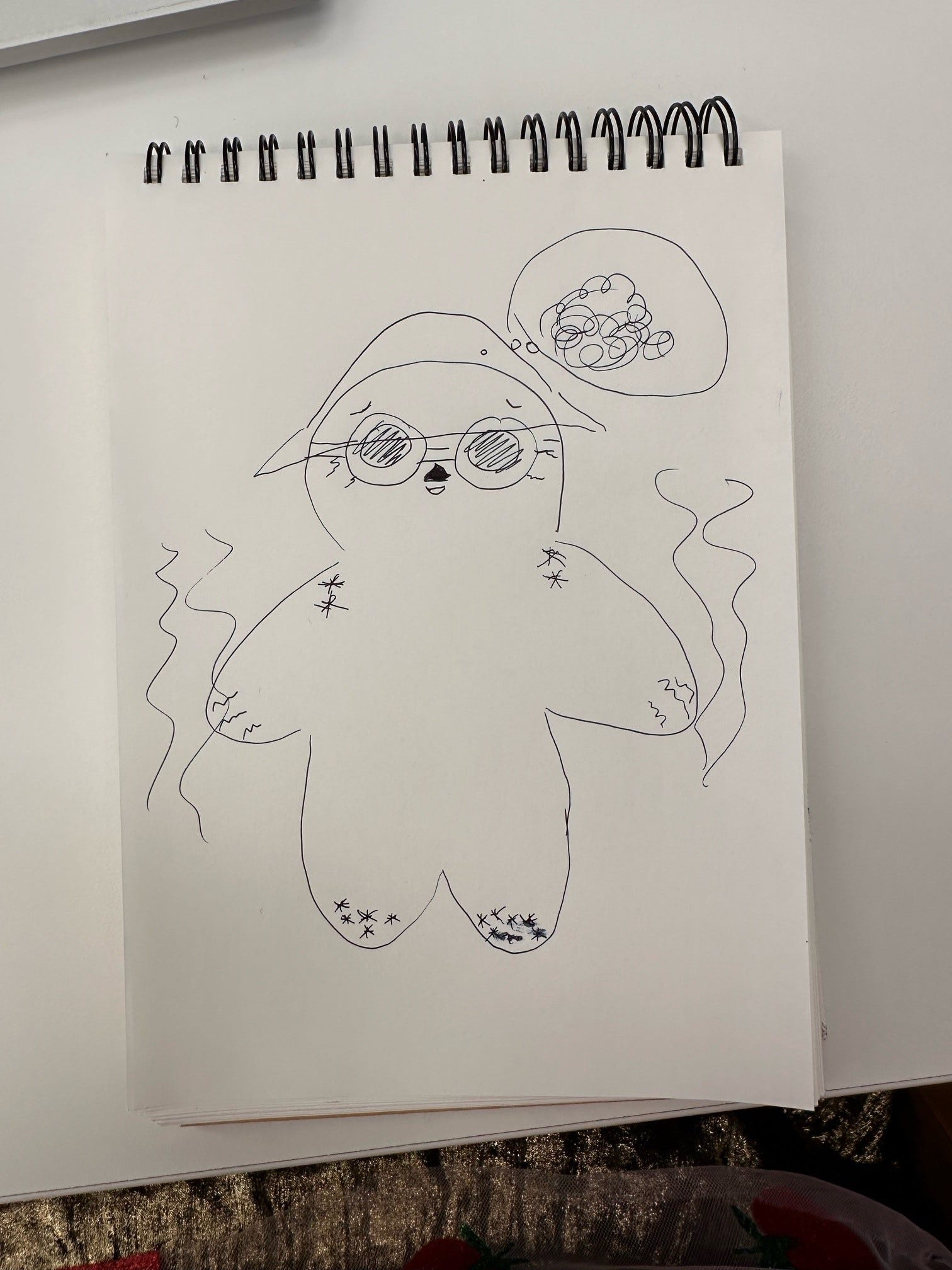
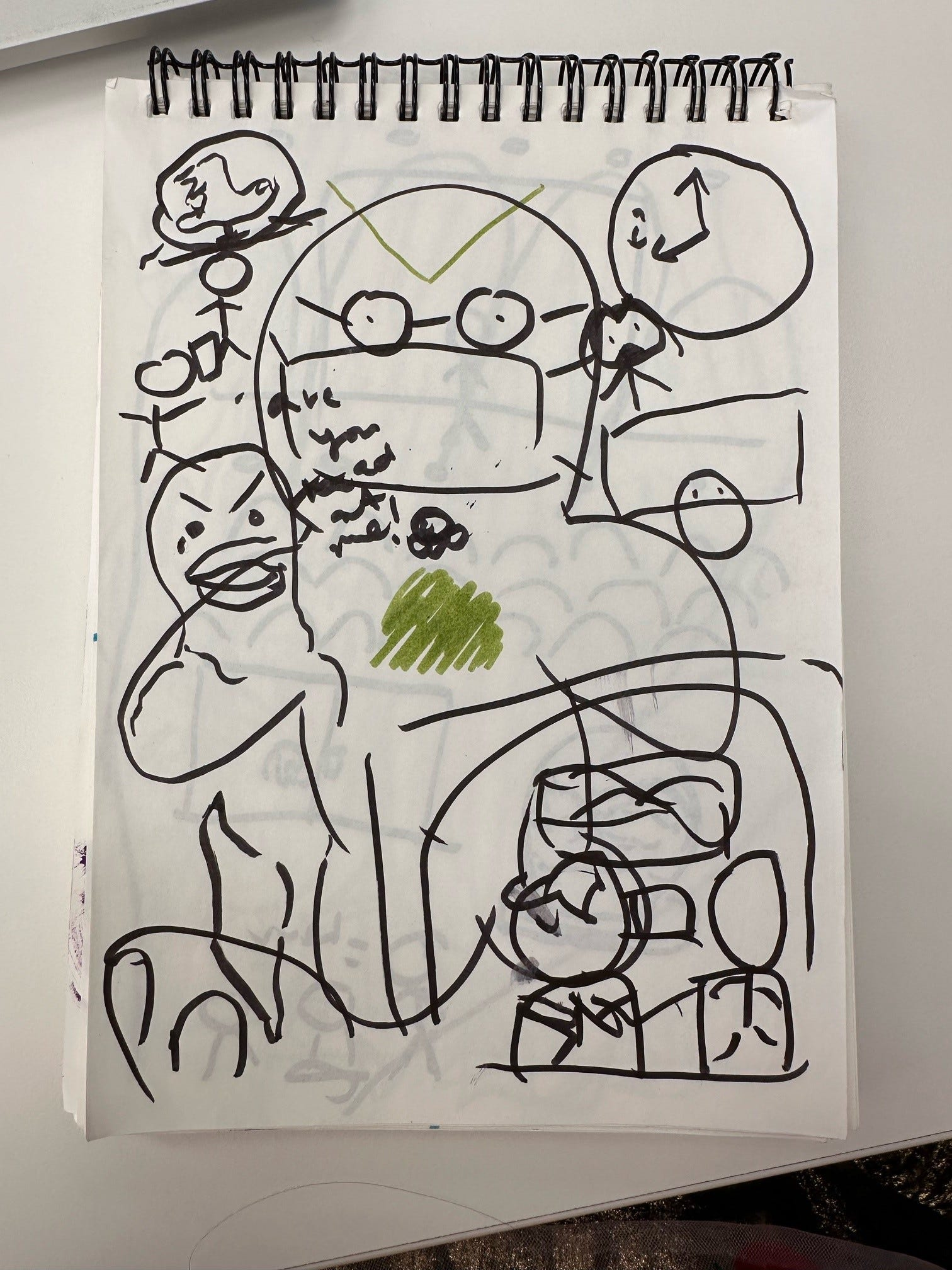
You can really see the difference between a low anxiety week and a high anxiety week. The left is actually from this week. I’m wearing a bucket hat and sunglasses because I was convinced I was going to accidentally look at the sun during the Eclipse and get blinded. The squiggles around the body and in the brain is representing my usual level of ADHD that is managed, there are little stars in places where I’m experiencing some discomfort, there are cracks on my hands because they feel dry, my nose is highlighted in a dark triangle because I’m experiencing allergies. Compared to the high anxiety week, the drawing is fairly sparse, small annoyances rather than overwhelming feelings. On the right, on a high anxiety week, you can see that I drew a bunch of scenes that I kept flashing back to, I’m wearing a mask and feeling green in the chest because I felt like I had a weight over those areas.
I’ve been thinking about it a lot because my partner has long COVID and has been trying to figure out some ways to keep track of their health and improvement/setbacks over time.
In fact, on of my favourite pieces combining art and data is this essay by Giorgia Lupi on her life with Long COVID.
Information Receptivity Matrix
- Is receptivity to data/information a better framing than technical vs non-technical? Can we retire ‘technical vs non-technical’ as a framing?Calling someone “non-technical” turns a context problem into a personal capability story. I think it’s a misunderstanding. My preferred… | Gabrielle Merite
Archive as Resistance
- How do we make history, contested histories, into dialogue? How do we ensure stories that are told are the ones the people about whom they are told would want? LITTLE JAMAICA resistance archive
Footnotes
-
Forthcoming later in 2026 ↩
-
“We are trained to think of data as proof but we know from experience that organisations are lived.” writes Ella Scheeper in the first part of this series. Practicing Attention in Organisations: What is Living Data? | Ella Scheepers posted on the topic | LinkedIn ↩